
One of the things that arose from the first text, Breath, was a series of questions. These arose from both ourselves and others who kindly spent their time reading the text. As we began to think about the second part of the project, Body, the famous phrase from Fanon continued to frame our thoughts. O my body, always make me one who questions!
There are many ways to explore this, not least the tension that is located here in realising that the body can often demand quiet, peace, avoidance. The body can resist questions. In the most simple sense, the question can be uncomfortable only if the discomfort is acknowledged as the bodies resistance to something that pushes it outside its comfort zone. Responses within habitual structures make up the content of the body and can easily begin to organise its form, pacifying it, keeping it calm and away from danger. One of the difficulties of learning is the realisation that we didn’t know. If this is taken abstractly it might seem like a liberation from ignorance but the real presence of learning, particulalry within the relationships that make up the human, is that the ignorance one is being liberated from wasn’t inconsequential but caused harm. “I didn’t mean to hurt you” is something we begin to learn as children.
The thought, then, was how to speak of a body that can make me one who questions without in some sense showing such questioning. This is not a performative process, but rather one in which the body that can make me question is encountered beyond the individual, within some kind of relation. One of the simplest ways of encountering this is in the question and answer process. To be allowed to question, to be able to even form a question, and to have a response – if not an answer – is a rare thing. Too rare. To ask a question, however, is also the first step towards learning. So there is some intricate and intimate connection between this capacity to ask a question and the body that supports or enables it.
It is almost impossible to imagine a body that can make me one who questions if we fail to take into account the relationship my body is in with others. In other words, my body is not simply mine, but is felt and lived as a body within the world. Imagine the classroom, meeting, assembly or other collective space of discussion, a concept critical to any functioning democracy for example. If we understand the body as a body within the world then the space of relationships the singular body is in is determined to a large degree by the space of the collective body. I am enabled – or disabled – by the collective body. Every teacher knows this, they know that the classroom environment has to be ‘conducive to learning’. In some spaces the very attempt to learn can be crushed by peer pressure (a name we give to the pressures of the collectve body on the singular body). Humiliation, shame, stupidity, manners, language idiom, gender, race, class – the collective body is made up of a whole series of these forces. There is no simple causation here, no easy answer to be found in the ‘right’ sort of behaviour, rather there is a mixture of modes that produces a particular cocktail of forces. Within this cocktail – within this world – there is a body and if we want that body to be able to make me one who questions we need to think about that mixture.
The result, for us, was an interest in questions from others, which then developed into the idea of developing conversations about concepts. That development, from questions and answers to conversation, should be explored elsewhere. What we want to do here is allow some of that question and answer process to be added to the particular mix of elements that makes up the Freudian Spaceship. To that end here are thirteen questions that arose and which we are trying to respond to. Some of the reponses have been developed already, some are still to come. Four responses to questions can be found below and we include the other 9 questions – so far unanswered – at the end.

Question 1: Does the actual body of Fanon matter or is it taking up the revolutionary call by wanting to make the body a provocation, a question?
The body always matters, but perhaps in ways we still find difficult to quite pick out clearly. It’s a vague term, which is not to say it’s useless, just that, like all vague terms, there is a very porous edge to the concept. It spreads out in all sorts of ways. What is the archetypical body? It’s probably the human body for most of us, even if we try not to be anthropocentric. If I sit in the landscape, on a hill, watching out across the rolling fields, I can very easily pick out the human body. I was standing at Stonehenge at the
solstice, looking out towards the sunrise that was imminent, a deep fog across the field, and out of the mist the human body appeared. Even in its blurred and dreamlike form I could tell, from the vaguest of shapes and movements that it was another human. I doubt any computer recognition software would be able to have identified the vague blurry shape as quickly as I knew, absolutely, that another human approached. We are attuned to the human body, so we see it first, and we see its differences acutely. Yet I’m not sure this is the right way in which to think about the body.
For example, I think we are tricked, by our evolutionary biological attunements perhaps, to notice the body in the landscape, the figure that might reveal itself to be friend or foe. This extends into the marks that body makes, shapes, buildings, roads, human remains. The so-called ‘wilderness’ is only wild in so far as it is absent such figures and marks. The desert of the non human, the absent human. Yet those deserts, those wildernesses, teeming with bodies, are themselves a body, just as much as the ocean or lake are bodies of water, or the flora and fauna of an area are constituted by the bodies that make up their specific character. So when I hear the word ‘body’ I’m never quite sure what I’m being referred to, what is being talked about. In recent decades philosophers have tried to put the body back at the center centre of things, but the vagueness of the concept allows all sorts of ambiguities to be let in through the back door. Having said all that, I think that there is still a powerful opening up of thought if we place the problem of the body, bodying and embodiment at the heart of analytical work.
In Chapter 4 of Black Skin, White Masks , Fanon discusses the way in which bodies are taken to be sources of explanation for colonial dependency rather than the results of colonisation . Fanon is arguing against the work of Mannoni and his argument has something like the same structure that we find in Anti-Oedipus , one of reverse causation which, crudely put, is the idea that the result has been taken for the cause. Pretty much the whole of Anti-Oedipus is grounded on this claim that Oedipus is a result taken for a cause, and as I say, this is the basic line of argument of Fanon in that chapter. What’s so powerful about this kind of inversion, this way of trying to upend and turn around a widespread understanding of how things are, is that it unsettles almost everything we take to be natural. In talking about Mannoni and his account of colonisation Fanon asks
“…why does he [Mannoni] try to make the inferiority complex something that antedates [comes before] colonisation? Here one perceives the mechanism of explanation that, in psychiatry, would give us this: there are latent forms of psychosis that become overt as a result of traumatic experience.” (BSWM, Grove 2008, 66)
He then carries on and offers an example, one that is perhaps central to the way in which I think Fanon’s account of colonisation can be extended into the general operation of capitalism, beyond racialisation and colonisation into what we might call the general sociogenic structure of the body . Having given an example from psychiatric medicine Fanon adds a parallel example, another inverted causality:
“Or, in somatic medicine, this: the appearance of varicose veins in a patient does not arise out of his being compelled to spend ten hours a day on his feet, but rather out of the constitutional weakness of his vein walls; his working conditions are only a complicating factor. And the insurance compensation expert to whom the case is submitted will find the responsibility of the employer extremely limited.” (ibid)
In both cases the examples are there to indicate the error of inverted causality, reversed causality, and it’s important that they begin from this question about why Mannoni takes this route of explaining things this way. It’s a kind of repression, a disavowal or expulsion of the reality of the way in which bodies are destroyed by social structures of power and exploitation.
Coming back to the question, I think one way of understanding the idea of making the body a provocation, one way of understanding this as a revolutionary call, is as a way of transforming the habituation to exploitation that the intellectual class carries out in its scientific naturalism without having to reject completely the possibilities of such scientific naturalism. In other words, we don’t have to simply say that ‘the Enlightenment’ or ‘scientific thought’ in general is the problem, and then retreat into some idea that everything worked fine in the halcyon days of old, a kind of reactionary response to the world that is often cover for avoiding the responsibility of facing up to the social structure. Instead we can pursue the problematics involved in the way our knowledge is presented and structured. If, as I think, there is a general structure of psychic or epistemic repression operating as the condition of any social structure that involves power hierarchy and exploitation, then the operation of that process of repression is what must be dealt with rather than a general disavowal of knowledge.
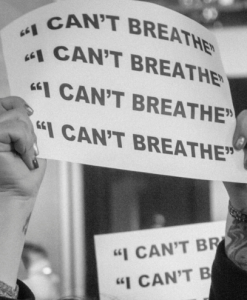
Question 2: What was it like writing so intimately about the death of Eric Garner only to hear the same words echoed with George Floyd?
In that same chapter of Black Skin, White Mask we find Fanon talking about anti-semitism and his relation to it:
“Anti-semitism cuts me to the quick; I get upset; a frightful rage makes me anemic; they are denying me the right to be a man. I cannot dissociate myself from the fate reserved for my brother.” (BSWM, Grove 2008, 69).
This is why I read Fanon, this kind of thing, where I feel like “this! this!”, where something is said that reinforces or reassures me in some ways that the rage I feel in these situations is not isolated, strange. That’s maybe not the right intellectual attitude, I will be dismissed as identifying too easily or being uncritical and unthoughtful, but this is a constant refrain from those who benefit from the system, from the privileged in all its forms, for whom these incidents are somehow mistakes, errors or anomalies in a social structure that is ‘fundamentally good’. What was so blinding and infuriating about the death of Eric Garner was the video recording, that it was possible to literally carry out such actions in the cold light of day, on record, in plain sight. There’s something horrific about all social structures of exploitation, but that horror is often hidden, in the shadows, perhaps even denied outright – “such things don’t happen here!” – and where they can’t be denied then they are justified, with narratives of necessity, of enemies or some other process of othering. With the death of Eric Garner and the recording of the incident on camera, at a moment when mobile phone video cameras and a YouTube video archive were just beginning to establish their ubiquitous presence in the social structure, it seemed like a new form of brutality. To be killed on camera, on record, openly, beyond the context of social conflict that might be found at a demonstration that has been attacked by the state forces for example, in the everyday, this seemed to open a window on the world of black lives in the USA at that moment. Of course such things can always be seen if you want to see, but the shock of that moment, it seemed to produce a new image.
To then find it happening only a few years later in almost an identical way, this was just horrible. Yet this second time it made something else happen. There was outrage and protest around Eric Garner’s death, it occurred just as the Black Lives Matter slogan was being originated, in the context of many other situations of the killing of black bodies, such as Trayvon Martin. It perhaps crystallised that slogan, “I can’t breathe” into something that expressed a new moment of the Black Liberation struggle in the US. Yet perhaps it wasn’t until the death of George Floyd that the slogan began to really act out, as it were, and we saw the simply fantastic resistance and rebellion of the uprising of 2020, in the midst of the pandemic, in a form that seemed to express a rage adequate to the horror. So it’s been a strange situation, working on this research project, thinking about Eric Garner’s death and then encountering this second moment of the George Floyd rebellion. I’m still not sure how to articulate what to do, or any such thing, but what it does reveal is movement and resistance, that things do shift, do change, that whilst the horror repeats, it produces a kind of learning in response, a learning yearning that can and will continue to articulate the new future, the new earth.
Question 3: In asking us to witness the time of the last breath, are we engaged in wake work?
You’re referring to Christina Sharpe’s book In the wake – on blackness and being which focuses on the question of living a black life in the wake of slavery. In a totally straightforward sense we’re not doing the same thing because we’re not focused on black life in the way Sharpe is. In a broader sense of the question, however, if we are to think of the methodology that Sharpe is developing in that work then perhaps yes, something connected to that is being done. I don’t want to say it’s the same, but it
feels like there is some sort of kinship, some kind of connection.
Take the most startling connection that occurred as I read Sharpes work in 2021. The book comes out in 2016, so I’m late to the party as usual. It’s a beautiful, haunting book and as I read I come across the section called ‘Aspiration’ in Chapter 4. Very quickly it becomes clear that there is a powerful connection to what we’ve been thinking about. “I’ve been thinking about what it takes, in the midst of the singularity, the virulent antiblackness everywhere and always remotivated, to keep breath in the Black body” (Sharpe, p109). Within the next two pages I find the chokehold and its history in Los Angeles, the account she gives of Eric Garner’s death, then finally the connection to Fanon. In particular I’m struck by the way she gives an almost verbatim account of the words of Mr Garner, the repetition of those words ‘I can’t breathe’, that moment of horror that forced us to think, the repetition of those words that we too began to think with. I’m struck by the way this moment provokes thought, as it were, all over the place, by a kind of connection to someone who was also, at the same time, forced to think about breath, Black lives and chokeholds. It’s almost spooky when these things occur, this reminder that we are not individuals with isolated thoughts but rather a community, of some kind, facing an event.
On the other hand I’m aware that collective responses to an event are also problematic, that the responses to an event are continuously organised and reorganised, that there is a class struggle within the body’s response, within the communities response, that it’s not simply free, it’s not simply mine, that it can be programmed and become a tool of domination as much as a moment of resistance.
Perhaps there’s a different question here. For Sharpe it’s a question of recovering and caring for Black life within a world of antiblackness. In some sense this is quite a direct and practical task and her book has much of its power to move from its capacity to enact such care, to do what it says. In my own case the question is allied but different. It’s more along the lines of asking about the inadequacy of response, why it is that we can encounter outrage, resistance, protest, raised voices of indignation at events of
oppression, catastrophe and disaster and yet the disaster continues. I feel like it’s too easy to be outraged, almost as though this is itself the symptom of a manipulated response, a deliberate accompaniment to disaster. ‘Let them say what they want, it will make them happy to vent their feelings (but change nothing)’.
Sharpe’s work is quite beautiful, but it’s also American. It’s quite specific – as it should be, this is not criticism – to the event of slavery in the Americas and the slave diaspora. Perhaps that specificity is most apparent in the forms of wake work that Sharpe calls ‘Black annotation, Black redaction’, where images and narratives are reorganised to try and recover the Black life within a variety of different documents and sources. However the other major form of wake work that Sharpe calls ‘aspiration’, this is something that seems close to what we’re trying to do, albeit in a different context. The connection here is again via Fanon and the way in which Sharpe wants to develop a sense of the weather of a world.
To explicate Fanon, it is not about the specifics of any one event or set of events that are endlessly repeatable and repeated, but the totality of the environments in which we struggle; the machines in which we live; what I am calling the weather. (Sharpe, p111)
In both forms of wake work I’ve just mentioned Sharpe gets beyond ‘response’ and moves towards ‘care’ and I think this is a vital step. The strongest sense of connection to the wake work of Sharpe, however, is via this sense of trying to develop a feel for the weather.
For example, the disaster that we live in is not an accident, it’s not a natural event, rather it’s a deliberate disaster. I’m reminded of the disagreement over the use of the word ‘anthropogenic’ when it comes to climate change. This comes down to a way of encountering the causes of events or repressing those causes through fighting over the language that we use to describe them. For those who want to make human society change its ways the word anthropogenic (as in ‘anthropogenic climate change’ rather than simply ‘climate change’) brings with it responsibility and strategy. We are then supposedly faced with a choice between facing our responsibility or avoiding it, and yet this hides a whole other set of narratives and options. Who is this ‘we’ in the ‘anthropogenic’? It covers over and obliterates the class war that has been carried out, increasingly violently, as a ruling class of humans stamped their world into the bodies of the vast majority of other humans. In doing so it obliterates the bodies of the workers, the bodies of those who have been forced, transported, into a world in which they have nothing but their labour power through which to survive. The weather system that gradually came to dominate the Earth, transforming the World and finally beginning to transform the Planet itself was no more a random event that the slave ships appearing on the horizon. Power, capital and wealth, private property and nation state government, these are all conditions of those events and are weather generating machines.
Question 11: Can you say more about breathing as the touch of life?
“Quantum theory provides us with a striking illustration of the fact that we can fully understand a connection though we can only speak of it in images and parables.”
Werner Heisenberg
It is difficult, perhaps too abstract, or the work of science, to give a concrete form to the touch of life. Analogies do allow us to think of the inverse of this, workers trapped within the mine. The headline used to be one of rescue, imminent death, but the day to day death was shutting down the life line, labour of the worker or entrapping and alienating the Zulu, or Xhosa man within compounds, thereby destroying a link to the family in rural areas.
Breath is habitually coded within the machine of capital. The blood, sweat and tears that the corporate machine demands of your breathing body, regardless of the levels of fatigue, so that the machine does not miss a beat in its production. Habituation, coded flesh, a meat factor with the stink of the bad breath of the owners of the means and modes of production.
Capitalist production occurs from its beginnings within the depths of the machine, as seen in in 1927 in Fritz Lang’s film Metropolis, but long before this, for 400 years it is out of sight, below deck, in the holdings of the slave ship. What is at stake is the surface and how the surface, skin, gets constructed. Our current situation is one that infantilizes a life, reducing a life to ‘bare life’ that has been made dependent upon choke holds that produce our bodies as they contain them.
It all happens below deck, in a theatre without a surface differentiating internal and external worlds. Dante’s inferno, in which the infant is “stage, actor and drama at once” (LOS, 215). The mouth-anus overlaps as there is no contact barrier to create a surface. Instead of introjection and projection creating a body-surface, the comings and goings of those who feed, we find a body-surface that folds into itself an adhesive identification with the aggressor. “Poisonous, persecutory, explosive and toxic” as “singular points, from a serial development articulated around the singularity and from the drive investing this territory” (LOS, 226).
It is not a question of ideology, but of the body, or rather, there is no ideology without the body. We have yet to get to grips with this, despite much effort. Whatever ideology is, it is closer to psoriasis, or proprioception, than it is to error, or illusion.
When Deleuze and Guattari call for a move from seeing the unconscious as a theatre to that of a factory, this is an act of making a transversal of the corporate machine,giving the body a skin. Again consider Deleuze reading of Klein.
“The erogenous zones are cut up on the surface of the body, around orifices marked by the presence of mucous membranes…as Simondon said of membranes, ‘the entire content of internal space is topologically in contact with the content of external space on the limits of the living’”. (LOS 226).
Put another way, the Kleinian process of reparation, forced concessions made to the worker, perhaps guilt about harm inflicted on a body, child labour, but more likely, anxious awareness of the greed to devour and as a result to destroy the very body upon which production depends.
“The process of ‘reparation’ on which Melanie Klein insists seems in this sense to belong to the constitution of a surface which is itself restorative”. (LOS 229).
To pacify the workers, a heroic gesture, to Oedipalise the strike but in so doing “organising surfaces”(LOS 229).
Esther Bick observes that infant-mother connections occur through touching of the skin, thereby bringing to life an organ that will contain by opening to touch and functioning as a boundary. Skin becomes skin only through the second skin, the touch of another skin, through “haptic form of sensory contact.” When one can breathe, is this what Campt in a different context calls the “haptic form of sensory contact?” (Campt, 2017, p 6). To be able to breathe as a contact, link to life, something felt but often not heard or seen, something that can give birth to a plurality of life forms.
This second skin gives skin a surface touch, some kind of logical interconnection and consistency, the passive synthesis of maternal touch, feeding, care, smell and attachment. At this moment the eruption of holes, partial objects/bodies/monads, such as mouth-anus, eat-cry, are organised through body to body incorporation of the external good object – maternal touch, feeding, care, smell and attachment – as an internal good object.
The skin and touch are for Bick the first object relation and it is this passive process, the first synthesis of time, that stops the child from the sense of fragmentation. Without the introjection of the touch of the skin the child can have no concept of space, a sense organisation of the body. The second skin makes the skin a body-surface, an emerging and core self that holds and contains.
The mother for Winnicott physically holds the baby but also holds the baby in mind, making it similar to Bion’s containment. Second touch assembles the skin as surface, no longer simply holes, but creating permeable membranes that function as a contact barrier. A contact barrier within a complex ecosystem, that functions as an interface, gateway, that links the closed-opening organisation of life breaths, human and earth. Without the passive synthesis of touching the skin the body leaks, as Bick puts it , and instead tries to create the second skin. The child develops a second skin defence, a pseudo-independent way of trying to contain emotions and prevent falling into the holes, a clinging and sticky connection in the absence of maternal holding.
It is difficult to imagine breathing as a life line touching the skin, unless, perhaps, we use the image of smells. Smells as the cluster of senses around links to other bodies that will give a particular body a sense of self, a core sense of self that runs parallel to the emerging sense of self. We can see smell as a haptic form of touch. The touch of touch within touching. To use Daniel Stern’s terms, a “non-self-reflexive awareness”, “sense at the level of direct experience, not mediated by self awareness” and “senses
of self prior to self awareness and language but sense of agency, physical cohesion, continuity in time.”
You wake up in the morning, it has been a shit week, you cannot make it to the end of the week, but the morning spring air, clear skies, outside, touches you, and despite the sense of fatigue you feel alive, linked to something more than you that nonetheless includes you. The most basic elements, units of existence encountering life and a life, which is the establishment of links. Humans and most animals are unable to survive without linking to fellow creatures and the earth. For Pichon Riviere madness often follows when people are unrooted and lose the sense of ecological internalisation of their environment, the land, soil, hometown. Without this internalisation, link, self identity breaks down (think of rural migrants to the city).
For Riviere the link is “a complex structure that includes the subject, the object and their mutual interaction through processes of communication and learning.” Learning, in the Bateson sense, is the capacity to interface with a second skin, the haptic touch of life. Riviere claims that there is no psyche outside links and we are unable to survive without links to others and our ecological system. The first phantoms and phantasies of the body, the movement in between the corporeal body and incorporeal,
is the establishment of links. Riviere states, the “unconscious fantasy is a function of links” but at the same time, this internal field, this “group is in constant interaction and dialectical relationship with the external group.”
But when territorialized and colonised, turned to face the habits of the corporate machine, the links go underground. The worker is forced into a double bind, to play multiple roles – mother, friend, woman – yet reduced to one role, stagnation, a cog in the machine. For Pichnon Riviere, to play two or more roles at the same time requires splitting. “Splitting allows us to perform different roles” but we need a degree of consistency between roles, a surface, permeable membrane. Instead the worker becomes both spectator and actor, a schizoid existence, atomisation of life-breath.
The links have gone underground, driven mad, they speak and seek connection, for “even in the most severe catatonic state” the worker seeks a “particular type of contact with the external world”. They express themselves “in small gestures” which are “transmitters that establish a language as a private morse code” that longs for respite – to come to the surface to breathe- and dreams of revolution – produce a surface, contact barrier, that decides what goes in and out. No longer a confused anus-mouth,
by a linking of “external, internal, time and space” (Pichon Riviere) . For Riviere “subjects are born from links and live links throughout their lifetime.” We are chained to our links, a chain which is always a “double chain”, transgenerational and contemporary, vertical link made of previous generation and horizontal link made of contemporaries. If the link links us to life, Pichon Riviere states, it “needs to have a synchronic and diachronic dimension.” There are “good links and bad links, not two instincts” and linked into the matrix, what Pichon Riviere calls, Gestalt, “modification of one part generates changes in other parts”. This is the overlapping of one to one, group and community relationships.
…
Question 4: Do you think that t he choke-hold that Eric Garner and George Floyd die from arises within “slavery’s brutal arithmetics” (Sharpe, 2016,p. 69), the large holding space in the ship to store cargo, what Christina Sharpe calls “the language of violence in the hold” (2016, p. 68)?
Question 5: When you speak of generosity, and assuming the cop is simply following orders, are you referring to Arendt’s “terribly and terrifyingly normal”? And is there a danger in granting generosity?
Question 6: The redundancy of the message, I can’t breathe, the fact that it cannot be heard, is this what Hartman calls the slave owner’s display of the “spectacular character of black suffering?”
Question 7: Are you saying we need to break the chains of thoughtlessness that have become habitual?
Question 8: Do you have Hume in mind when thinking about habit and its associative pathways?
Question 9: In speaking of habits of capital, could you play with the idea by thinking alongside Bateson, where he states that habit is “a major economy of conscious thought” (Bateson, 2000, p. 142)?
Question 10: If you fail to comply, you die, or is it something more sinister, you are marked with the markings of death, never knowing when you will die, but knowing that it will be a premature death, that you will be killed off one way or another?
…
Question 12: I like this concept of “good and bad links, not two instincts” but wonder about something here. The normative, the value, the ‘good and bad’, these distinctions seem vital but they’re also confusing. We can quickly end up in all sorts of arguments about what makes something good or bad and my inclination is to think of these as markers of things that enable life to flourish or that fuck it up. The philosophers will call this ‘eudaimonism’, the kind of ethics that originates in Aristotle. But my curiosity starts with wondering about what produces the difference between the flourishing and the fuck up. I want to say that here is the role of the breath as a drive, why we still need something like a drive, as well as connections, good and bad links. Does the breath operate like a first drive because it produces the primal difference between life flourishing or fucking up?
Question 13: In Section 4 of the Breath text we say that ‘the moral of the tale consists in the destroying or imprisoning of intensities, subsumed into systems of redundancy and “organising them into molar aggregates”. This is the capitalist colonisation of the molecular breath’. Is the body itself, in general, a result of molecular breaths organised into molar aggregates?